Understanding breast cancer
What is breast cancer
A short, plain explanation.
Breast cancer is a disease in which cells in the breast start to grow out of control. As they build up they can form a lump or an area of thickening. It most often begins in the milk ducts, and it can happen to women of any age, and rarely to men too.
Found early, breast cancer is very treatable, and most breast changes turn out not to be cancer at all.
Breast cancer is the most common cancer in women. About 2.3 million women are diagnosed with it around the world every year, and in South Africa about 1 in 27 women will have it in her lifetime. More women survive it every year, especially when it is found early.
How cancer begins
Every cell in your body carries a set of instructions called DNA. The DNA tells the cell when to grow, when to do its job, and when to stop. Sometimes that instruction set gets damaged. Usually the body spots the faulty cell and clears it away.
Now and then a damaged cell slips through and keeps dividing when it should not. Over time those extra cells can build up into a tumour. Most of the time we never learn what caused that first bit of damage, and it is almost never anyone's fault.
Normal cells and cancer cells
The difference, in everyday terms.
Healthy cells grow, do their job, and die off in an orderly way, making room for new ones.
Cancer cells ignore those signals. They keep dividing, crowd out healthy tissue, and can spread.
A benign lump is an overgrowth that stays in one place. It is not cancer and often needs no treatment.
A malignant lump is cancer. It can grow into nearby tissue and, if left, travel to other parts of the body.
When it stays, and when it spreads
How far it has spread is what shapes the plan. Caught before it spreads, breast cancer can often be cured completely. If it has already travelled further, it usually cannot be cured, but it can be held back for a long time.
In place (in situ)
The cancer cells are still inside the duct or lobule where they began and have not grown into the breast around them. This is the earliest, most treatable stage.
Doctors describe how far a cancer has spread using stages 0 to 4. You can read about stages on the Diagnosed page.
How a breast is built
Knowing the parts makes the rest of the guide easier to follow.
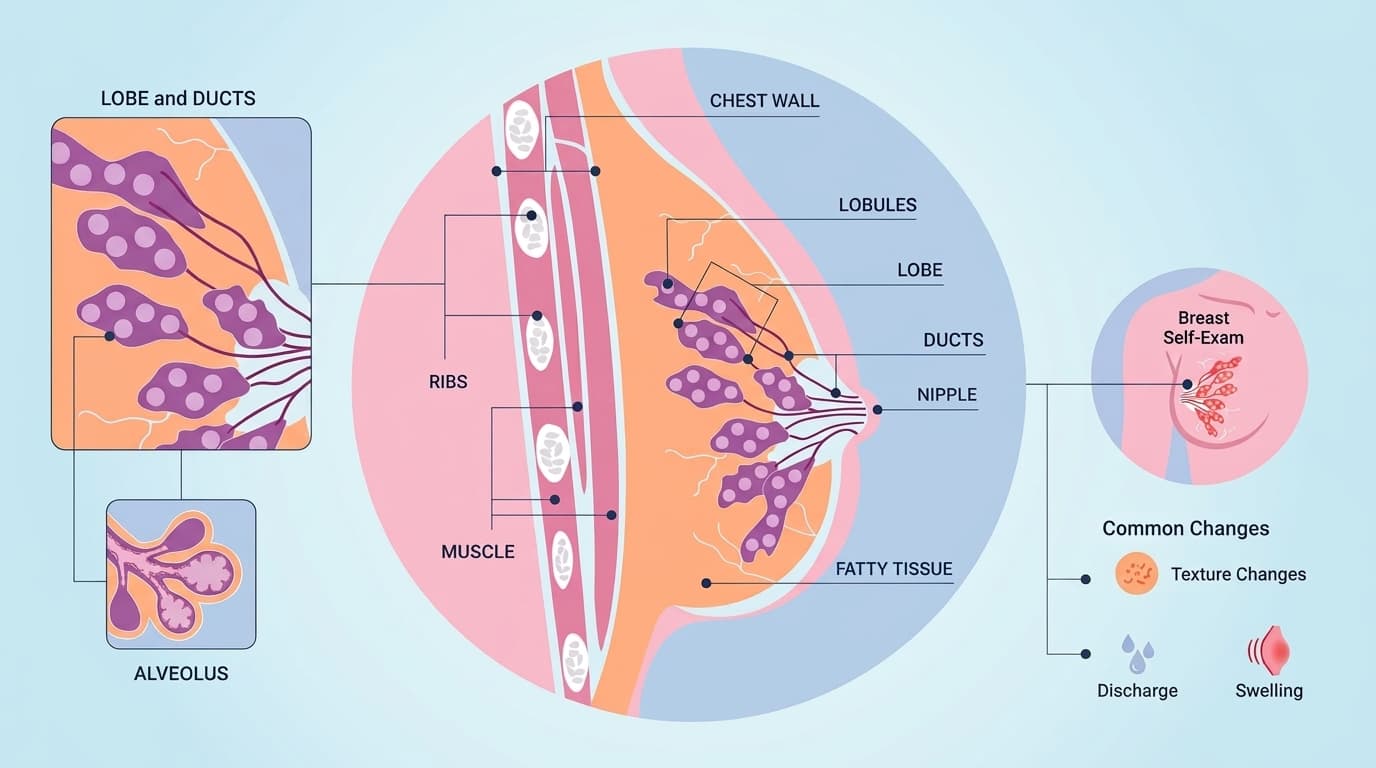
Lobules
Lobules are the tiny glands that make breast milk. They are grouped together in sections called lobes.
The lymph system
Running through the breast and into the armpit is a network of thin vessels and small glands called lymph nodes. This is part of the body's drainage and defence system, and it helps fight infection.
The lymph nodes under the arm matter in breast cancer because they are often the first place the cancer can spread to. That is why a doctor will feel under your arm during an examination, and why these nodes are sometimes checked or removed during treatment.
Where breast cancer starts
Most breast cancers begin in one of two places.
In the ducts. Cancer that starts in the milk ducts is the most common kind, called ductal.
In the lobules. Cancer that starts in the milk-making glands is called lobular.
Breast cancer is also sorted into types by testing the cells for three things: two hormone receptors, oestrogen (ER) and progesterone (PR), and a protein called HER2. Which of these show up decides the type of breast cancer, and which treatments will work against it. You can read about each type on the Diagnosed page.
Myths and facts
Plenty of common worries about breast cancer are simply not true. It is not contagious, and it is not caused by bras, deodorants, or cell phones.
Have a question? Talk to someone.
CANSA's toll-free help line is free and confidential.